
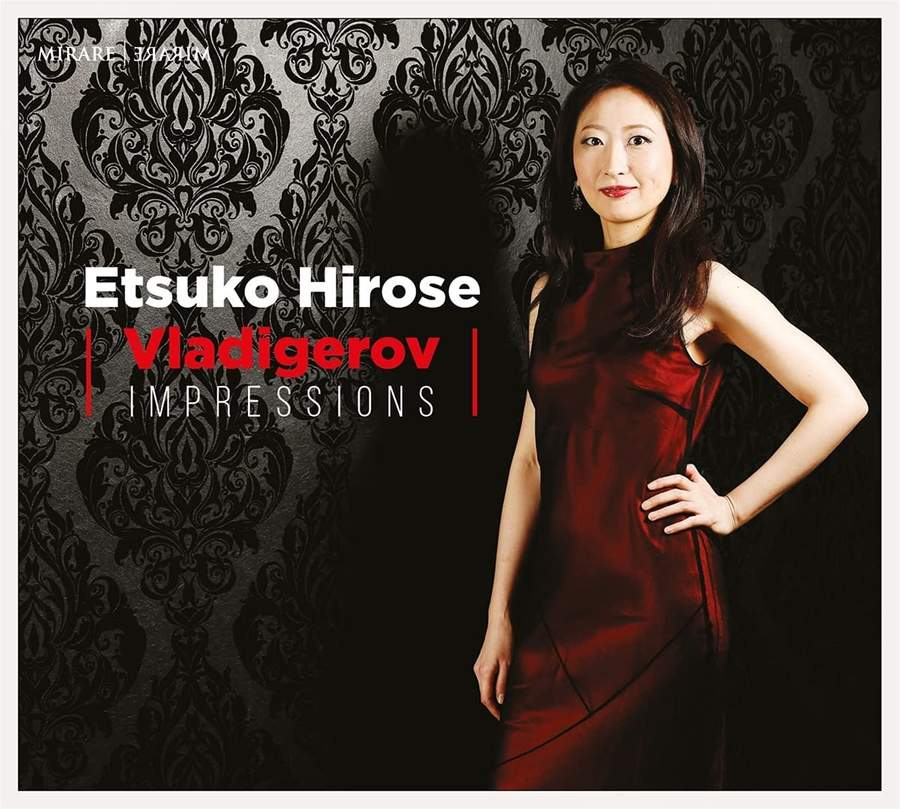
Impressions, Op.9
Bulgarian Suite, Op.21
Prelude, Op.15
Etsuko Hirose Piano
Mirare MIR600
Full price
The Review
Although Pancho Vladigerov (1899-1978) is a composer whose music has not sustained a big international reputation, in his native Bulgaria he is highly regarded. Apart from other achievements, in his twenties he was one of the founders of the Varna Summer Music Festival, one of Europe’s oldest and still most distinguished annual events.
Even so, it is unusual repertoire for a Japanese pianist of Hirose’s pedigree to record in Paris but I am very glad she has. The Impressions, which won Vladigerov the 1920 Mendelssohn Prize in Berlin, are true delights: highly individual, perhaps closer to Ravel than Debussy or Scriabin, and very unlike the music coming out of post-World War I Germany.
The other two works here are from the same period. The Prelude is obviously influenced by Rachmaninov but is quite accomplished enough to withstand the comparison. Vladigerov’s view of Bulgaria in the eponymous Suite is much gentler than Kodaly or Enescu’s of the neighbouring countries. Suk’s Czech forays are nearer the mark. This was a time, sadly only a few years long, when so many eastern and central European countries were tasting freedom from empire. Bulgaria’s Turkish connections are clear in the music, though, especially the melismatic elegy of the second movement: particularly beautiful. The other movements sparkle without being raucous.
As a Jewish foreigner, a few years later Vladigerov was in severe danger in Nazi Berlin. He returned to Bulgaria rather than following so many of his colleagues to America. It is hard to say whether this was a mistake but it did cut off his opportunities to build a solid worldwide reputation. Sofia became a Cold War backwater and he was not radical enough to become a symbol of resistance in his later years, seemingly content in his role as a national treasure. Sofia’s National Academy of Music is named after him. The vicissitudes of 20th century political fashion should not, though, count against his work and it is high time for a reappraisal.
Etsuko Hirose is a most persuasive interpreter; always secure, eloquent and refreshingly gentle, giving the music plenty of breathing space. There is never a hint of unnecessary force but consistently appropriate firmness. She has chosen a good piano too: a subtle Bechstein rather than the more usual but harsher Steinway. This album is a delicious surprise, highly commended, and one that will now be returned to often.
SM