
Piazzolla
Le Grand Tango
Revirado
Introduccion al Angel
Muerte del Angel
Milonga del Angel
Violentango
Undertango
Michelangelo 70
Tangata
Soledad
Decarismo
Adios Nonino
Suite Porteno de Ballet
Libertango
Buenos Aires Hora Cero
Verano Porteno
Fuga y misterio
Oblivion
Praxedis Hug-Rütti Harp
Praxedis Geneviève Hug Piano
Ars Produktion ARS 38592
2 CDs
Full price
The Review
Astor Piazzolla had the same problem as Scott Joplin; known for only one genre of music, confining himself to a set of rules that makes all the pieces feel interchangeable – Joplin with ragtime, Piazzolla with the tango.
The two forms were vital for the distinctive development of music in their countries – USA and Agentina respectively – but the constant repetition of the form can be wearing unless experienced in the boozy smokey atmosphere of a late night dive.
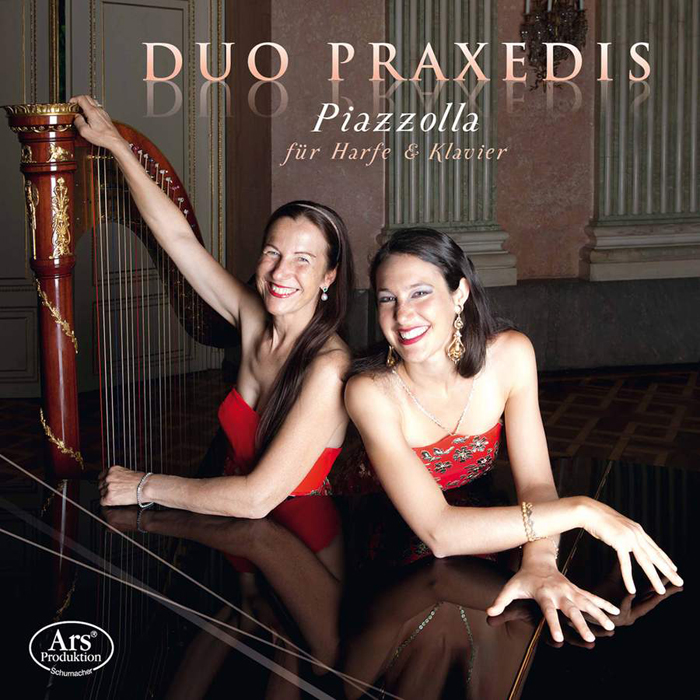
Listened to in domestic surroundings and played on the genteel combination of modern piano and harp by, I assume, a related pair with similar names who may or may not be Swiss (the liner note is not completely enlightening), the fascination dims, though the music is never less than pleasant.
The problem with having a plucked string instrument in a duo with a struck one is that the ear tries to convince you that one or the other is out of tune. They are not but the contrasting timbres (mellow harp and smooth Steinway) somehow get in each other’s way.
This is not a criticism of the playing. Both Praxedes (Praxedises ?) play beautifully – if anything, a little too beautifully. Small doses are enough. It becomes the music equivalent of neatly wrapped balls of Lindt milk chocolate: the first two are delicious but by the end one needs a stiff gin or a pint of lager and some chilli nuts. These two CDs give a combined time of 103 minutes.
The arrangements could do with the addition of an instrument or two with more bite to give variety. The proof of this comes in the middle of the second disc, when Buenos Aires Hora Cero calls for some bird squarks and crow taps on the harp’s wood. Suddenly the interest perks up. It is followed by Verano Porteno, which starts with some argumentative rumbling in the piano’s bass before retreating into safety for a while.
For the most part, though, as presented here it is too tempting to think of Duo Praxedis giving of their best in the tea salon of a Waldorf hotel. If none of that matters, then there is plenty to enjoy. It is playing of easy charm, performed with glossy elegance, and as musical therapy it is delightfully relaxing.
SM