
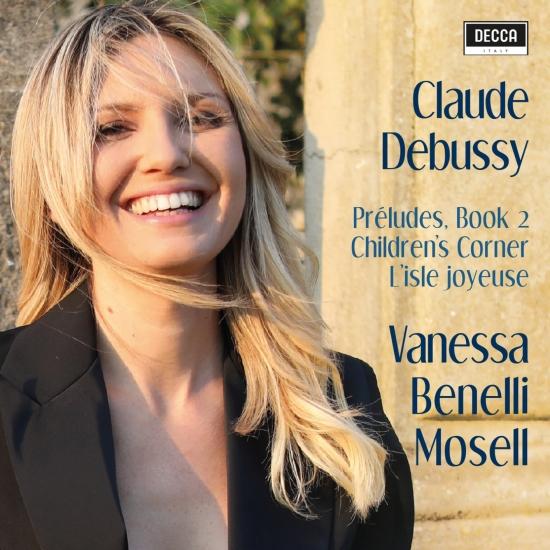
Preludes, Book 2
Children’s Corner
L’Isle Joyeuse
Vanessa Benelli Mosell Piano
Decca 4856807
Full Price
The Review
The very difficulties that made Debussy’s second book of Preludes seem confusing in 1913 are those that make them so appreciated today. They are clearly 20th century and their disjointed, episodic character, moving in fits and starts between fragmented ideas, looks forward to a sound world in the 1920s that Debussy never lived to see.
These pieces are the ground work for generations to come. Inevitably, then, they are hard to pull off as a musical sequence; to find a balance between restless energy and lyrical flow. They are quirky too, without the common purpose that binds together the Preludes of Bach or Shostkovich.
Mosell manages these issues pretty well, though she is inclined to dwell too long on phrases so that momentum dissipates. She paints the clown General Levine nicely, catching the daftness, but Bruyères and La terrase des audiences du clair du lune settle down a little too much. The music becomes becalmed. Ondine, the underwater nymph, darts and sparkles but feels brittle, probably a characteristic of the Steinway on which Mosell is playing as much as her interpretation (there are moments when I wonder about its tuning too). Canope, an exercise in calm, is hardest of all to bring off, requiring interpretive insight of great maturity. Mosell comes close but I suspect she will perform it with greater depth ten years from now. Feux d’artifice is my least favourite piece in the book but it is in its virtuosity, rapid changes of mood and deft fingering that Mosell is most at home. It feels closest to her natural verve and suggests why Decca has such faith in her.
Children’s Corner is musically easier but some parts are technically just as hard. Debussy expects the pianist to be beguiling while negotiating a forest of notes or sustaining playful simplicity. Mosell opts for primary rather than water colours. Her articulation is always definite, never sentimental. This is a perfectly valid approach, and emphasises the pianism, but I miss a touch of warmth. There is something rather fierce and matter of fact about her view of the child. The snow in the fourth piece does not so much dance as clatter down. The golly struts a cakewalk with all the jerkiness of Chaplin on unreconstructed film stock. Again, it is a reasonable interpretation but I would prefer to live with one that had more affection.
L’Isle Joyeuse portrays Debussy’s passionate visit to Jersey with his then mistress, Emma Bardac, in 1904. In Mosell’s hands the memory of their time on the island is more frantic than joyous – as if there had been a lot of rows in the bedroom – and, by taking it so fast, she misses much of the emotional grandeur. All in all, I came away from this disc wanting her to go away and think about the music more deeply without trying to impress with technical ferocity.
SM