
Sir Thomas Allan Narrator, Dr. Pangloss
Leonardo Capalbo Tenor (Candide)
Jane Archibald Soprano (Cunegonde)
Anne Sofie von Otter Mezzo-soprano (the Old Lady)
Thomas Atkins Tenor (ensemble parts)
Marcus Farnsworth Baritone (Maximilian and ensemble)
Katherine McIndoe Soprano (ensemble)
Carmen Artaza Mezzo-soprano (Paquette and ensemble)
Lucy McAuley Mezzo-soprano (Baroness and ensemble)
Liam Bonthrone Tenor (ensemble)
Frederick Jones Tenor (Baron, Grand Inquisitor and ensemble)
Jonathan Eyers Baritone (ensemble)
London Symphony Chorus
Simon Halsey Director
London Symphony Orchestra
Marin Alsop Conductor
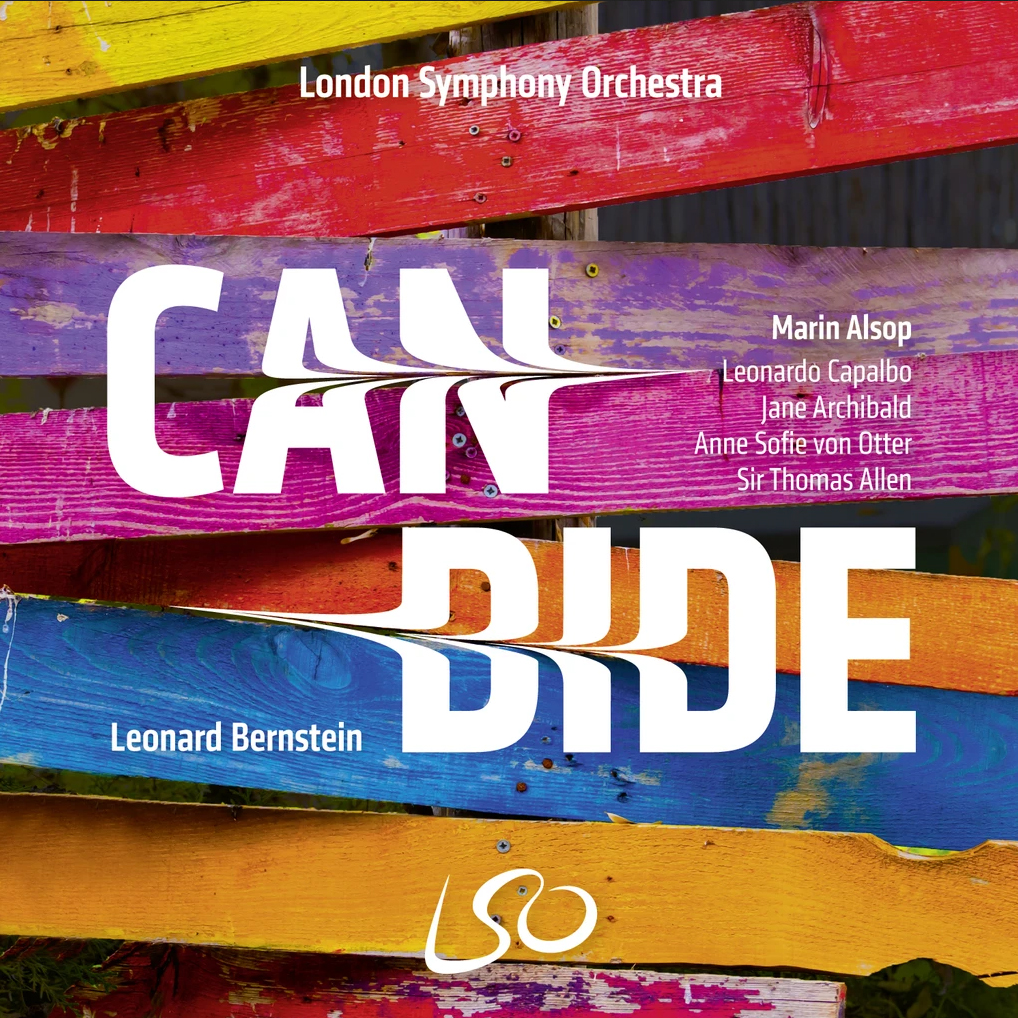
LSO Live LS 0834
2 CDs
Full price
The Review
Not only is this a wonderful performance, superbly captured by Andrew Cornall’s recording, it is timely in the best tradition of political satire.
Voltaire would have loved what Bernstein, Lillian Hellman and Richard Wilbur (Sondheim too) did with his novel, written as he, like Candide himself, travelled Europe escaping tyranny and disaster. Bernstein would have loved this concert rendering, with clever and informative narration by Hugh Wheeler and incisive conducting by Marin Alsop.
The politics are worth dwelling on, as Candide, Dr. Pangloss, Cunegonde and her chaperone survive by the skin of their teeth or just have multiple lives, all made horrible or ended by the upholders of state authority or religious orthodoxy. In 1954-56 Bernstein and Hellman were aiming at the Un-American Affairs Committee, presided over by Senator McCarthy in Eisenhower’s time as President, which both regarded as overseeing an appalling infringement of civil rights. It is worth quoting Hellman’s words, written ten years later, in her introduction to the collected stories of her companion, Dashiell Hammett, the doyen of American detective story writers. “In 1951 he went to jail because he and two other trustees of the bail bond fund of the Civil Rights Congress refused to reveal the names of the contributors to the fund. The truth was that Hammett had never been in the office of the Committee and did not know the name of a single contributor. The night before he was to appear in court, I said, ‘Why don’t you say that you know the names?’ ‘No,’ he said, ‘I can’t say that.’ ‘Why?’ ‘I don’t know why.’ After a nervous silence, he said, ‘I guess it has something to do with keeping my word but I don’t want to talk about that. Nothing much will happen, although I think we’ll go to jail for a while, but you’re not to worry because… I hate this damn kind of talk but maybe I better tell you that if it were more than jail, if it were my life, I would give it for what I think democracy is and I don’t let cops or judges tell me what I think democracy is.’ ”
Voltaire was dealing with the Spanish Inquisition and Louis XV, Bernstein, Hammett and Hellman were putting up with the political xenophobia of 50s America, and when the LSO gave this performance in 2018, we were all having to contend with Boris Johnson, Donald Trump and his fellow bullies in China, Turkey, Poland, Hungary, Belarus, much of Africa and too many Middle-Eastern states to list – and now the list is getting longer and the bullying worse. Candide cocks a snook at the lot of them. The sheer tasteless banality of vindictive populism, as practised by the above, is summed up perfectly in the chorus lyric, “What a day, what a day, For an auto-da-fé! It’s a lovely day for drinking and for watching people fry”.
As to this performance, the real hero is Sir Thomas Allen, whose narration is bristling with sarcasm and whose singing as Dr. Pangloss (yes, the voice is still magnificent) conveys just the right level of wry disappointment and determined optimism. Best of all, not a syllable is blurred. The others, the splendidly heldentenor caricature of Leonardo Capalbo’s Candide and Anne Sofie von Otter’s deliciously raddled Old Lady, carry the story with verve and proper gusto. The minor parts and chorus are faultless. My only casting quibble is over Jane Archibald’s Cunegonde. For me she is just over-ripe; a less Queen of the Night sound would fit the role better. Cunegonde needs to have a touch of frail Mimi throughout, whatever fates, soldiers and old goats throw at her. Archibald’s best is very good but imperfect. Still, the final scene with its glorious anthem, ‘We build our house and chop our wood, And make our garden grow’, should and does leave a heavy lump in the throat.
Marin Alsop was Bernstein’s assistant and most talented protege. She drives the music forward with just the right combination of vibrant operetta and Broadway vim. The recording was made thirty years after Bernstein’s own with the LSO. They are totally justified in keeping the link alive.
SM